ETL platforms with hundreds or thousands of connectors are often treated as a shortcut to better data. The thinking is simple. If a tool connects to everything, it must be the safest choice.
In practice, it's more nuanced than that.
Most day to day analytics depend on a small set of systems that need to run reliably, stay understandable, and support real decisions. That's why many teams move away from broad ETL platforms and toward data management tools designed to do a smaller number of things well.
Most Teams Rely on a Small Set of Core Data Sources
Across industries, most data stacks look surprisingly similar. Companies typically rely on fewer than 20 sources, including:
- A CRM
- One or two databases or data warehouses
- Marketing or acquisition platforms
- Finance or billing data
- Product, behavioral, or operational data
Even teams with well established data practices usually have 10 to 20 sources that consistently appear in dashboards, reports, and forecasts. Other integrations tend to be one off, short lived, or rarely used.
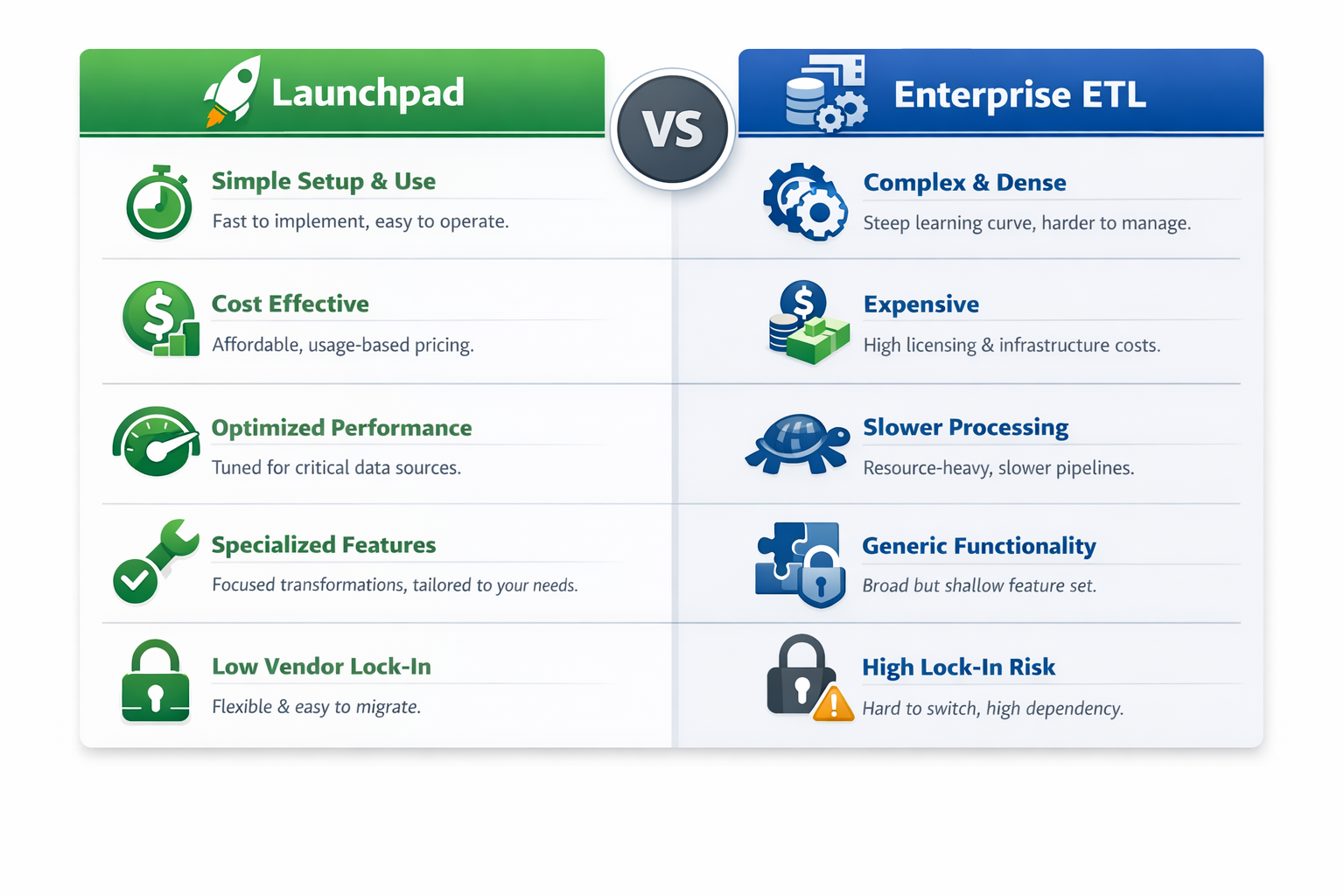
When a data management platform is built to support hundreds of connectors, teams often pay for flexibility they don't use while taking on complexity they didn't ask for.
Where Large ETL Platforms Start to Break Down
When teams struggle with ETL, missing connectors usually aren't the problem. The issues are more familiar:
- Pipelines are hard to debug
- Transformations feel fragile or unclear
- Jobs fail without useful context
- Costs grow faster than insight
Platforms designed for extreme breadth tend to trade simplicity for flexibility. That tradeoff shows up quickly in day to day work, especially when teams only need a handful of integrations to run extremely well.
Calibrate's Launchpad Data Management Platform was built to avoid those pain points.
How This Plays Out Across Real Use Cases
Retail and Ecommerce
Retail teams depend on a tight loop of data from ecommerce platforms, POS systems, ad platforms, brick and mortar activity, and inventory or fulfillment tools.
What matters is consistency. Revenue, conversions, and inventory metrics need to match across systems, especially during peak seasons.
Travel and Hospitality
Travel and hospitality teams work with booking engines, property management systems, metasearch, CRM data, and marketing platforms. When pipelines break or drift, reporting gaps show up fast.
Clear transformations and manageable pipelines make it easier to compare bookings across systems and spot issues caused by cookie consent regulations, regional differences, or tracking gaps without digging through layers of abstraction.
Healthcare and Medical Services
Healthcare teams typically work with critical systems where data accuracy and lineage matter more than connector counts.
Reporting pulls from patient systems, operational databases, billing data, and engagement tools. Launchpad's no-code transformations and dependencies make it easier to audit logic, manage schema changes, and understand how metrics are built.
What Teams Gain From a More Practical ETL Platform
Pipelines That Are Easier to Maintain
Smaller ETL setups tend to be easier to reason about. With fewer integrations and clearer patterns, pipelines are easier to read, update, and hand off between teams.
Analysts can work closer to the data without running into unnecessary complexity, and engineers spend less time untangling fragile workflows that grew too fast.
Cost That Matches Real Usage
When ETL tools aren't built around hundreds of unused connectors or oversized infrastructure, costs stay tied to actual usage.
With our Launchpad platform, eams pay for the data they rely on every day, not hypothetical future integrations that may never happen.
Performance Where It Matters
More streamlined pipelines make it easier to prioritize the data flows that teams depend on most. Performance tends to be more predictable, and failures are easier to spot and diagnose.
When data supports revenue reporting, operations, or leadership decisions, reliability matters more than optional breadth.
Clear Transformations and Data Lineage
Smaller ETL setups usually allow for deeper, more transparent transformations instead of shallow coverage across many sources. That means:
- SQL-based transformations that stay readable
- Clear lineage and dependencies
- Practical handling of schema changes, partial loads, and reprocessing
These patterns make it easier to build pipelines teams trust in production.
Less Lock In, More Control
With fewer moving parts and less hidden logic, teams retain more control over how data flows through their systems.
Debugging is faster, governance is clearer, and pipelines are easier to adapt as requirements change. That flexibility tends to matter just as much over time as it does on day one.
More Direct Support and Accountability
Smaller ETL setups like Calibrate also come with more hands-on support. When platforms and implementations are simpler, teams aren't routed through layers of generic support or long ticket queues.
Instead, questions are answered by people who understand the pipelines, the data, and the business context behind them. That kind of white glove support is hard to find with large ETL vendors built to serve thousands of customers at once, but it matters when pipelines break and decisions are waiting on data.
How Calibrate Analytics Helps Teams Get It Right
The goal isn't more integrations for the sake of it. It's data that shows up when it's needed and holds up when decisions are on the line.
Calibrate Analytics works with teams who want ETL to feel manageable instead of overwhelming. Launchpad helps you design and maintain pipelines that support the systems businesses actually rely on, with clear transformations, reliable jobs, and data teams can trust.