Click here to download the case study PDF
As organizations plan for 2026, analytics teams are under pressure to do more than report on the past. Data-driven businesses require clearer answers, faster insights, and practical ways to apply AI and automation to revenue decisions. The challenge is that many teams attempt to layer advanced tools on top of foundations that are not ready.
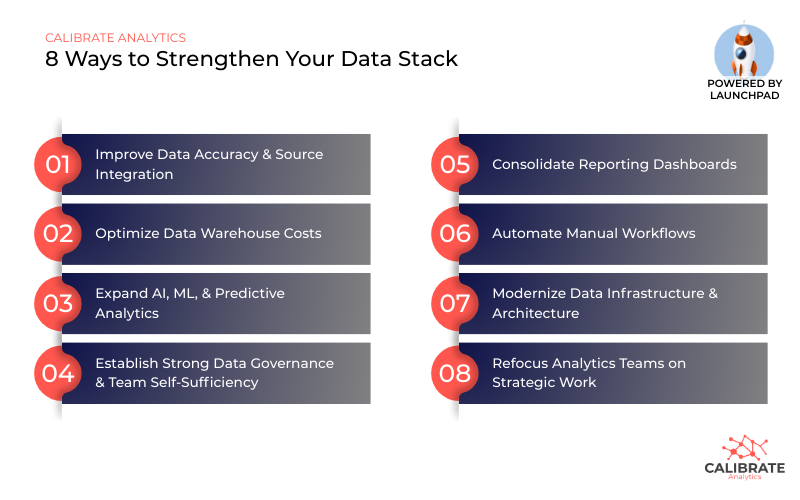
A successful analytics strategy starts with a strong foundation. These eight recommendations reflect the most common gaps we see across marketing, ecommerce, and enterprise analytics teams, and the priorities that will have the greatest impact on revenue, efficiency, and AI readiness next year.
1. Improve Data Accuracy and Source Integration
Analytics confidence breaks down when core systems do not agree. Discrepancies between GA4, ad platforms, and production data create uncertainty and slow decision-making.
Focus on stabilizing APIs, aligning schemas, and resolving known tracking gaps across platforms like GA4, Meta Ads, Google My Business, and paid media and CRM systems. Clean integration and consistent definitions create a reliable baseline for performance measurement.
Why it matters: Accurate data improves targeting, forecasting, and personalization while reducing time spent QAing the numbers.
2. Optimize Data Warehouse Costs
High BigQuery and warehouse costs are often the result of inefficiencies rather than scale. Common issues:
- Querying more data than necessary
- Maintaining unused datasets
- Dashboards that refresh too frequently or inefficiently
A structured review of query logic, storage practices, and refresh schedules can significantly reduce costs without sacrificing performance.
Why it matters: Lower infrastructure costs free up budget for experimentation, testing, and growth initiatives.
3. Expand AI, ML, and Predictive Analytics
AI adoption is moving beyond static dashboards toward proactive insights and forecasting. Teams are increasingly applying machine learning to surface trends earlier and automate insight delivery.
Use cases include:
- Conversational analytics in Slack or Teams
- Automated Google My Business review responses
- Customer sentiment analysis
- Fraud detection
- Performance forecasting tied to real outcomes
Why it matters: Predictive insights enable earlier, more confident decisions that improve marketing efficiency and ROI.
4. Establish Strong Data Governance and Team Self-Sufficiency
As data ecosystems grow, governance becomes critical. Clear ownership, documentation, and standardized workflows reduce errors and accelerate onboarding.
A centralized data management approach allows teams to unify marketing, CRM, and operational data while enabling analysts and marketers to manage workflows independently using no-code tools.
Why it matters: Strong governance improves trust in analytics while reducing dependency on engineering resources.
5. Consolidate Reporting Across Teams
Fragmented reporting slows down insight discovery and creates misalignment across stakeholders. When performance lives across dozens of disconnected reports, teams lose valuable time reconciling numbers instead of acting on them.
Bringing key data sources into a consolidated performance view improves clarity, consistency, and speed.
Why it matters: Faster access to trusted insights enables quicker optimization and better business decisions.
6. Automate Manual Analytics Workflows
Manual report extraction, spreadsheet data entry, and recurring reporting tasks continue to consume valuable hours you could be spending on strategy.
Common candidates:
- Email attachment parsing
- Chatbot and social channel data capture
- Scheduled report refreshes
- AI-powered analysis and recommendations
Why it matters: Automation shifts analytics teams from maintenance work to strategic insight generation.
Read more about how to automate email attachment ingestion here.
7. Modernize Data Infrastructure and Architecture
Legacy pipelines and fragmented systems limit scalability and slow innovation. A modern analytics architecture supports reliable data flows, flexible storage, and future AI use cases.
This includes reviewing pipeline stability, refresh reliability, and whether current systems can support streaming or advanced modeling as needs evolve.
Why it matters: Scalable infrastructure is the foundation for advanced analytics and reliable AI deployment.
8. Refocus Analytics Teams on Strategic Impact
High-performing analytics teams focus on insight, not just output. When analysts spend most of their time troubleshooting data issues or maintaining dashboards, business value suffers.
The most effective teams invest in automation and structure so analysts can focus on forecasting, experimentation, and revenue-driving insights.
Why it matters: Strategy-driven analytics functions contribute directly to faster, smarter revenue decisions.
Getting Ready for 2026
Preparing for AI, automation, and advanced analytics does not start with new tools. It starts with assessing your current foundation and prioritizing the areas that create the biggest impact.
Need help mapping a practical 2026 roadmap? Contact the Calibrate Analytics team to start planning.