AI adoption has accelerated quickly across every industry. Companies are rolling out AI-generated reporting, automated summaries, forecasting tools, chatbot integrations, and operational workflows powered by large language models.
But many organizations are discovering that implementing AI successfully requires more than connecting a new tool. The performance of your AI strategy depends heavily on the quality, accessibility, and structure of your data environment.
Without a strong data foundation, even advanced AI tools can generate incomplete, unreliable, or misleading insights.
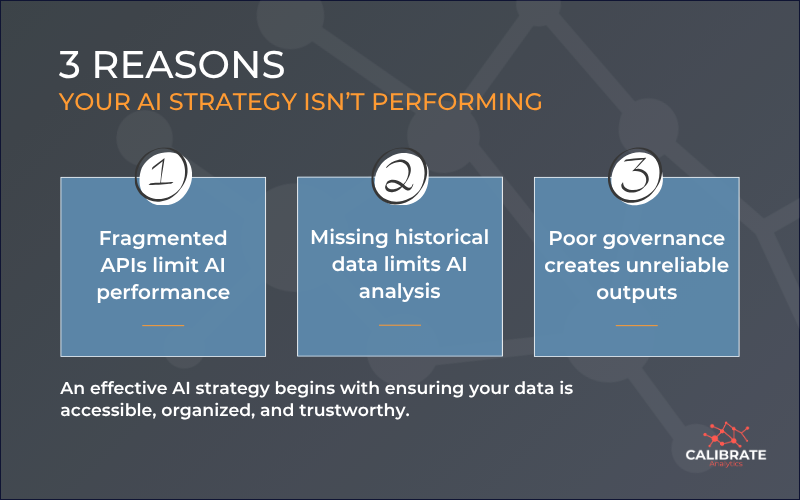
Here are three common reasons AI strategies underperform, along with practical steps to fix them.
Reason 1: Assuming AI Can Read APIs Reliably
One of the biggest misconceptions around AI is that it can analyze data directly from platforms like Google Analytics, Meta Ads, CRMs, PMS systems, or reservation systems without additional infrastructure.
In reality, most native APIs weren't designed for scalable AI workflows. They often include:
- Rate limits
- Inconsistent schemas
- Data retention restrictions
- Fragmented dimensions and metrics
- Limited cross-platform visibility
For example, a hospitality company may have website analytics in GA4, paid media data in Google Ads and Meta, booking information in a PMS, and customer insights inside a CRM. If those systems remain disconnected, AI tools can't generate a complete and accurate view of business performance.
How to fix it:
Centralize your data inside a warehouse environment like BigQuery. Structured warehouse environments allow AI tools to work with normalized, queryable datasets instead of fragmented APIs.
Benefits are:
- AI can query normalized datasets instead of fragmented APIs
- Reporting logic becomes more consistent
- Historical data becomes easier to analyze
- Automated summaries become more accurate
- Forecasting models have cleaner inputs
- You can ask natural language questions against centralized business data
As AI adoption grows, centralized data infrastructure is becoming a critical part of long-term analytics strategy.
Related article: Chat with Your Data Using Looker Studio Pro, BigQuery, and Launchpad
Reason 2: Waiting Too Long To Archive Historical Data
Another major issue is assuming platform data will always remain available.
Many advertising and analytics platforms (including Google) limit how long granular historical data is retained. Depending on the source, detailed reporting data could only be accessible for months before aging out of the platform entirely.
This becomes a major problem for AI-driven forecasting, trend analysis, anomaly detection, and long-term performance modeling.
AI and machine learning systems improve when they have access to larger historical datasets and broader context.
How to fix it:
Export your analytics and advertising data into BigQuery or another warehouse before retention windows expire.
Without long-term historical storage, you risk losing the ability to:
- Analyze multi-year trends
- Compare seasonality
- Train forecasting models effectively
- Preserve granular campaign-level reporting
- Benchmark AI-generated insights against historical performance
Proactive data archival also reduces dependency on platform-native retention policies and creates a more stable foundation for reporting and AI analysis moving forward.
Related article: How to View Historic Data From Google Search Console Past the Previous 16 Months
Reason 3: Using AI Without Establishing Data Governance
AI can expose existing data quality issues very quickly.
If tracking is inconsistent, naming conventions vary across teams, attribution logic changes frequently, or KPI definitions are unclear, AI-generated outputs become unreliable.
Common examples:
- Duplicate GA4 events inflating reporting
- Poor campaign naming structures producing inaccurate summaries
- Fragmented dashboard logic creating conflicting insights
- Inconsistent tagging leading to attribution issues
As AI becomes more integrated into reporting and operational workflows, governance becomes increasingly important.
How to fix it:
Build standardized data governance practices before scaling AI initiatives.
That includes:
- Standardized KPI definitions
- Clean event tracking structures
- Consistent campaign naming conventions
- Reliable transformation logic
- Centralized reporting governance
- Clearly documented data pipelines
Organizations with strong governance structures are better positioned to generate reliable AI insights, automate reporting, and scale analytics operations efficiently.
AI Success Starts With Data Infrastructure
AI implementation and data strategy are now closely connected. Companies that centralize their data, preserve historical information, and establish strong governance frameworks are in a much stronger position to scale AI initiatives successfully.
Building an effective AI strategy starts with creating an environment where data is accessible, organized, and reliable.
At Calibrate Analytics, we help companies adopt AI through centralized data warehousing, reporting infrastructure, automation workflows, and scalable analytics environments designed for long-term growth.