
Data engineering has become an important part of how businesses use data for decision-making. The reason is straightforward: business intelligence depends on the data systems underneath it.
You may invest in dashboards, machine learning models, and agentic AI, but those tools can only perform well when they have reliable data to work with.
If data arrives late, contains errors, lives in disconnected systems, or requires constant manual intervention, the value of everything built on top of it declines.
This is why data engineering is moving from a behind-the-scenes technical function to a core business capability.
Data Pipelines Are the Foundation
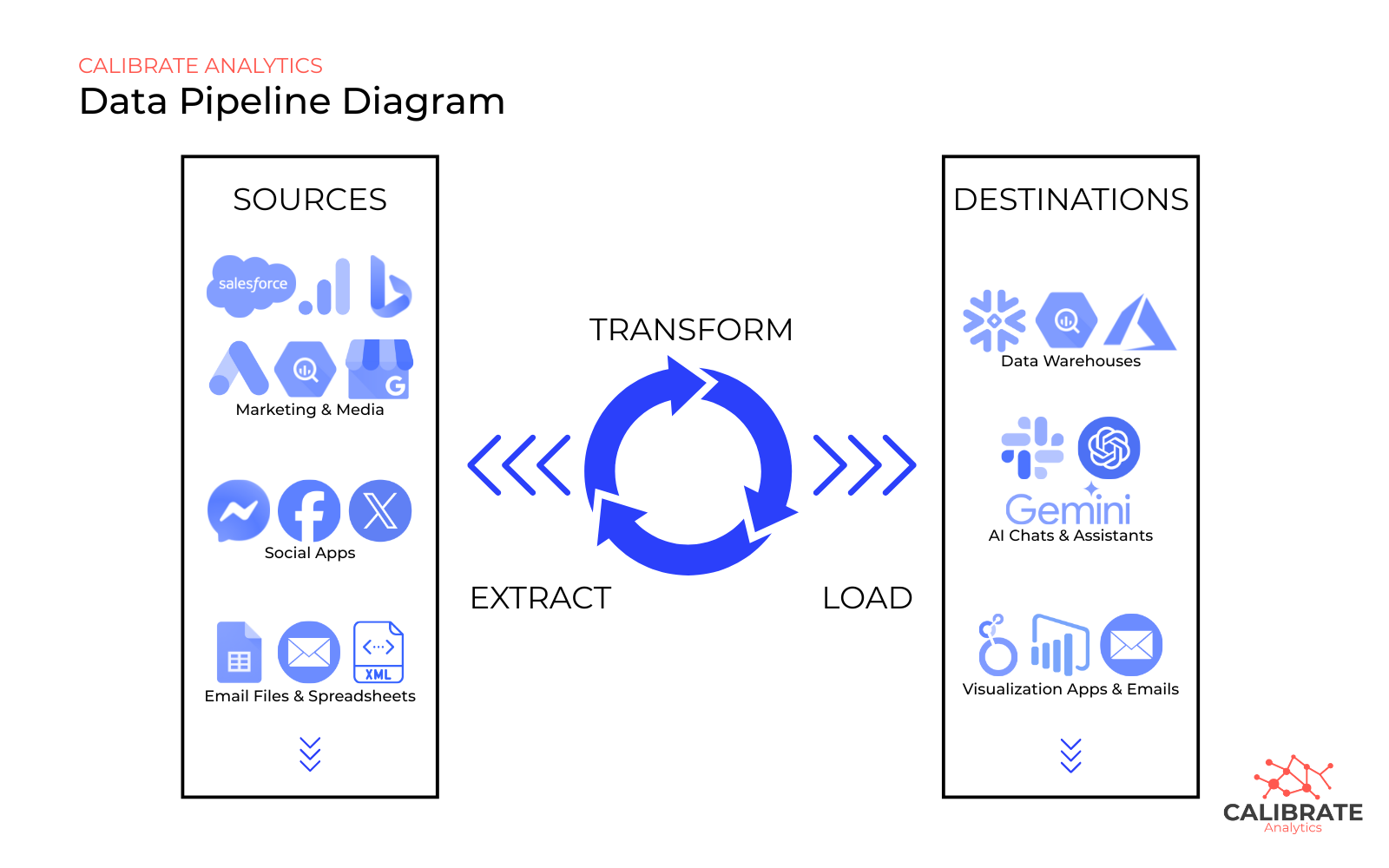
A data pipeline moves information from its source to the systems where it can be analyzed and used. It involves extracting data from databases, advertising platforms, APIs, or cloud storage, transforming it into a consistent format, and loading it into a warehouse, reporting platform, customer system, or AI environment.
This process is commonly known as ETL: extract ---> transform ---> load.
When pipelines are designed well, you rarely think about them. Reports refresh on time, data stays consistent across systems, and decision-makers can trust the information in front of them.
When they don't, the problems are familiar:
- You spend hours fixing spreadsheets.
- Reports show conflicting numbers.
- Data arrives late or incomplete.
- Failed jobs require repeated troubleshooting.
- Manual processes introduce errors.
- People lose confidence in reporting.
- AI applications use incomplete or poorly structured data.
For many businesses, the biggest obstacle to better analytics is the data foundation supporting the tools they already use.
Related article: Modern Data Pipelines - A Guide to Data Management, Real-Time Analytics, and Leveraging the Right Kind of AI
What Effective Data Engineering Looks Like
The best approach treats data engineering as an ongoing capability rather than a series of one-off projects.
Instead of creating a new integration every time someone requests a report, you can build reusable workflows that support multiple reports, use cases, and business functions.
Several priorities set this approach apart:
- Reliability: A pipeline that works most of the time isn't enough when executives, customers, and operational teams depend on its output. Monitoring, validation, error handling, and recovery should be built into important workflows.
- Automation: You can reduce manual file transfers, spreadsheet preparation, and recurring data cleanup so analysts spend more time interpreting information and less time preparing it.
- Reuse: Standardized pipelines and shared data models can support reporting, forecasting, customer analytics, and AI without requiring a separate integration for every use case.
- Business outcomes: Data engineering should support measurable goals such as faster reporting, improved campaign analysis, more accurate forecasting, lower operating costs, or better customer experiences.
- Data quality: Quality checks should be part of the workflow rather than something you discover after data reaches a dashboard. You can check for missing records, duplicates, unexpected values, and other issues before they affect reporting.
Together, these practices create a stronger foundation for analytics. Once the underlying workflows are in place, adding new data sources and use cases becomes easier.
Related article: Using Anomaly Detection to Catch Data Pipeline Problems Before They Reach Your Dashboards
Data Engineering Capabilities That Matter
Automated Data Movement
Recurring data collection should require as little manual work as possible. You can automate scheduled workflows, file processing, API extraction, and other repetitive tasks so information reaches its destination consistently.
Automation also reduces the risk of missed steps. A repeatable workflow is less dependent on someone remembering to download, clean, and upload a file every week.
Flexible ETL and ELT
Most businesses work with multiple types of data sources. You may need to combine information from APIs, databases, spreadsheets, advertising platforms, CRMs, and other systems.
A flexible approach lets you extract and transform data where it makes the most sense for the workflow. Google Cloud's current BigQuery capabilities, for example, support SQL transformations, scheduled pipelines, continuous queries, and data preparation workflows.
Workflow Orchestration
Data jobs often depend on one another. A reporting table may need to update only after several source datasets have finished loading. Another process may need to run only when a validation check passes.
Orchestration allows you to define those relationships, control execution order, and add conditions to a workflow. This reduces the need for fragile scripts or manual coordination.
Data Quality Controls
A successful data job doesn't necessarily mean you have good data.
You can build checks into your workflows to identify missing records, duplicates, unexpected values, schema changes, and other issues before unreliable information reaches business users.
This is particularly important because a polished dashboard can make poor-quality data look authoritative.
Data that Supports AI
AI initiatives add another reason to pay attention to the underlying data.
AI applications may need structured business information, historical records, current data, documents, or other sources to produce useful results. If that information is incomplete, inconsistent, or difficult to access, the AI application inherits those limitations.
Reliable data workflows can support traditional reporting as well as forecasting, machine learning, generative AI, and other advanced use cases.
Faster Development With Less Complexity
Not every data integration requires a large engineering project.
No-code tools help analysts and technical teams create workflows faster, particularly for common data movement and transformation tasks. You can reduce custom development while still maintaining appropriate controls around security, scalability, and governance.
The right level of engineering depends on the problem. A simple reporting workflow shouldn't require the same amount of development as a highly complex enterprise system.
How Calibrate Supports Data Engineering
At Calibrate, we help businesses improve the data workflows behind their analytics, including data integration, transformation, cloud data architecture, warehouse development, reporting, and ongoing optimization.
You can use our Launchpad platform to extract data from multiple sources, transform and organize it, coordinate dependent jobs, process files received by email, update databases, and deliver data to cloud warehouses and reporting systems.
For businesses with focused integration needs, a streamlined approach can make it easier to automate the work that matters most without adding unnecessary complexity.
If you're looking at your current reporting processes and wondering where better data engineering could save time or improve the quality of your analytics, get in touch with Calibrate Analytics to talk through your options.